What Causes ADHD? A Guide for Families
What Causes ADHD? A Guide for Families in Columbus, Hilliard & Lancaster, Ohio Medically reviewed…
or

At Ohio Psychiatric Services, we believe that mental wellness requires a deeply personalized approach. Your brain, your history, and your goals are entirely unique to you. That is why our team of psychiatric providers, therapists, and counselors work collaboratively to offer a full spectrum of compassionate mental health care - blending traditional healing with advanced, innovative clinical treatments.
Whether you are seeking a supportive, warm space to process life’s challenges, looking for careful and understanding medication management, or exploring breakthrough therapies for symptoms that haven't responded to traditional care, we are here to walk with you every step of the way. You don't have to navigate this journey alone.
Explore our comprehensive care options below to find the path that feels right for you:
Taking the first step toward mental health care can feel daunting, but you are in safe hands. Our comprehensive initial evaluations are unhurried, deeply validating conversations designed to understand the whole picture of who you are. We look beyond your symptoms to establish an accurate diagnosis and a clear, compassionate roadmap for your healing journey.
Finding the right balance with medication requires careful attention, expertise, and a provider who truly listens. Our ongoing services go far beyond simply writing a prescription. We partner with you to closely monitor how you are feeling, fine-tune dosages, and ensure your treatment safely supports your daily well-being.
Navigating life with a fast-moving brain can feel like an uphill battle against overwhelm and chronic stress. Our comprehensive ADHD testing provides clear answers and validation for adults and children alike. From there, we build a tailored treatment plan combining careful medication management and practical strategies to help you calm the chaos, regain your focus, and thrive.
(Esketamine) Nasal Spray
For many individuals, finding true relief means exploring alternative, natural pathways to healing. We provide comprehensive, compassionate evaluations to determine your eligibility for a medical marijuana card under Ohio state guidelines. Our goal is to safely and legally integrate this plant-based therapy into your broader mental wellness plan to help alleviate chronic distress and improve your daily quality of life.
(Esketamine) Nasal Spray
A fast-acting, in-office treatment administered in a safe, comforting environment, specifically designed for adults finding it difficult to find relief from severe depression.
Also available: Genetic Testing · Telehealth · Urgent Primary Care Services
At Ohio Psychiatric Services, we understand that living with mental health challenges can feel overwhelming, exhausting, and deeply isolating. Whether you are dealing with a sudden crisis or managing a long-standing, complex condition, your struggles are valid and relief is possible. Our team meets you exactly where you are with a combination of deep empathy, advanced clinical expertise, and a commitment to finding a treatment plan that actually works for your life.
We provide comprehensive, specialized care for a wide range of psychological and psychiatric conditions, including:
Also treat: Dementia · Insomnia · Panic Disorder · Substance Induced Psychosis · Schizophrenia
Free TMS or Spravato® consultations for patients with treatment-resistant depression
Medically reviewed by Max M Haque, Cari Callaway, PMHNP, Ohio Psychiatric Services- Updated August, 2026
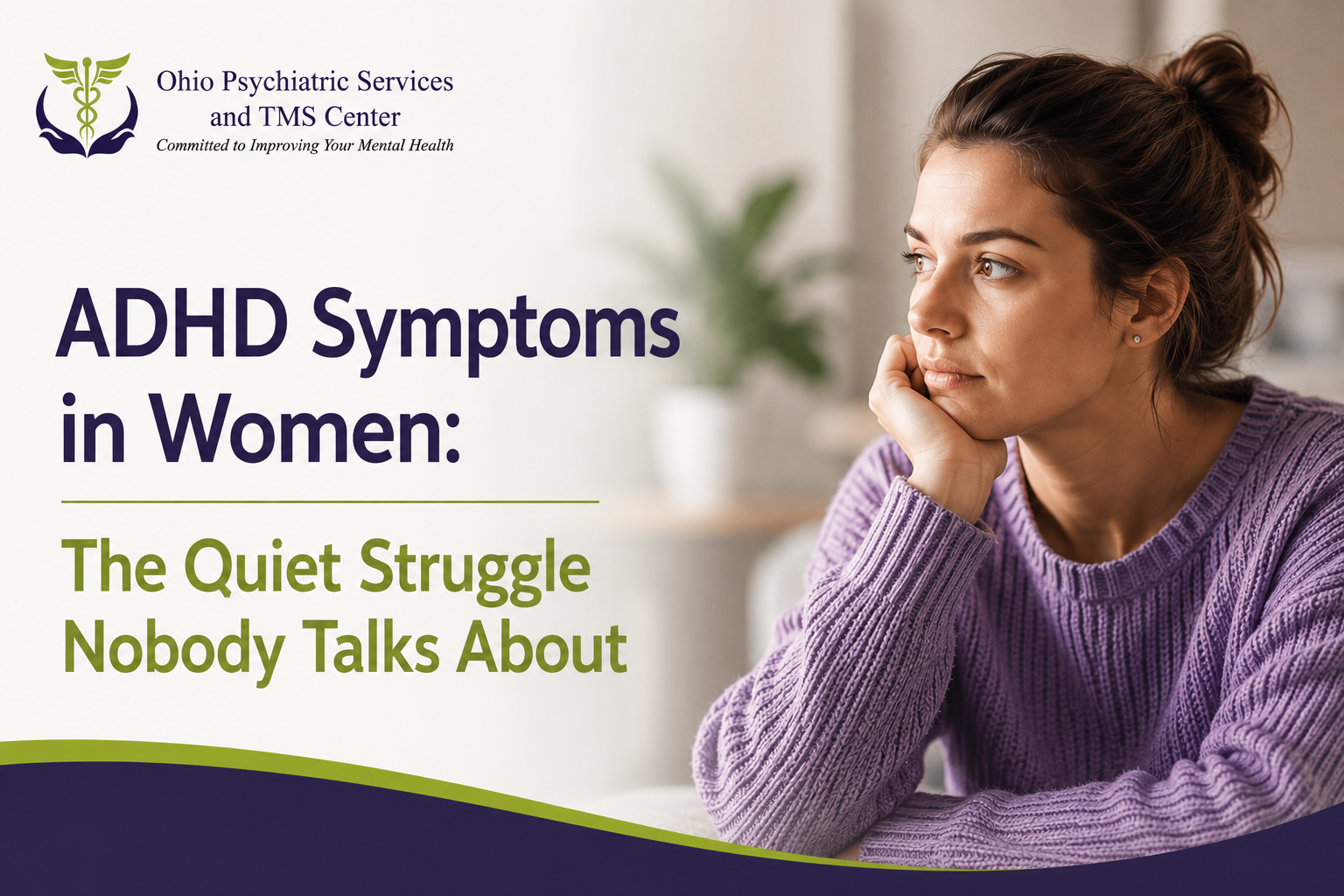
Think about this. Your brain is like a browser. It has 47 tabs open. Music plays in one tab. You can’t find it. Some tabs are frozen. And people still say “just focus.”
That’s how many women with ADHD feel. Every day.
“Understanding my ADHD has helped me ask for what I need instead of feeling
sorry for needing help.”
— Inspired by Natasha Rothwell
Here’s the thing. When people think of ADHD, they picture a boy. A boy who can’t sit still. So when a woman has ADHD, no one notices. Not her teachers. Not her doctors. Sometimes not even her.
She thinks she’s just messy. Or too emotional. Or lazy.
She’s not. Her brain just works in a different way. No one taught her to see the signs of ADHD in women.
Let’s look at why.
Here’s what ADHD symptoms in women often feel like, day to day.
What It Can Look Like | What She Experiences |
Too much going on | She starts many things, finishes a few, and may forget what she even started. |
A mess that won’t go away | It’s not because she’s lazy. Sorting and organizing things simply takes more work for her brain. |
Big feelings, fast | One small comment can leave her crying or angry. She may not understand why it affected her so strongly. |
Time slips away | She plans for 10 minutes, and suddenly two hours have passed. Or she thinks she has plenty of time and ends up being late. |
Tired by midweek | Even small tasks can leave her feeling drained. Everything starts to feel like too much. |
A busy mind, not a busy body | Her brain rarely goes quiet. She’s not necessarily bouncing off the walls—her thoughts are simply racing nonstop. |
Working extra hard to keep up | It’s not always about wanting to be perfect. “Good enough” may not feel safe, so she overprepares for everything. |
Zoning out | She can drift away mid-conversation, mid-task, or during everyday activities, then “come back” and realize she missed part of what happened. |
Read that list again. Sounds like stress, right? That’s the problem. These signs of ADHD symptoms in women can look like stress. So everyone thinks that’s all it is.
Here’s the part people skip. It’s not just about behavior. It’s about brain chemistry.
Dopamine and estrogen work as a team. Dopamine is a brain chemical. It controls focus, motivation, and reward. People with ADHD naturally have lower dopamine activity. That’s part of why focusing feels so hard.
Now bring in estrogen. Estrogen actually boosts dopamine. It helps dopamine work better in the brain. So when estrogen is high, symptoms often feel more manageable. When estrogen drops, dopamine drops with it. And symptoms often get worse.
This is a real, physical link. It’s not “just mood.” It’s chemistry.
The brain itself develops a bit differently, too. Research shows ADHD affects parts of the brain tied to focus, planning, and self-control. These parts can grow a bit slower, or just work a bit differently. This is one of the few spots where ADHD in women vs men looks the same. The real difference is estrogen. Men don’t get the same monthly hormone swings women do. So their symptoms tend to stay steady over time. A woman’s symptoms can shift, week to week, because her hormones shift too.
So ADHD itself isn’t “worse” at its core when you compare ADHD in women vs men. But the hormone swing on top of it makes her experience of it swing too.
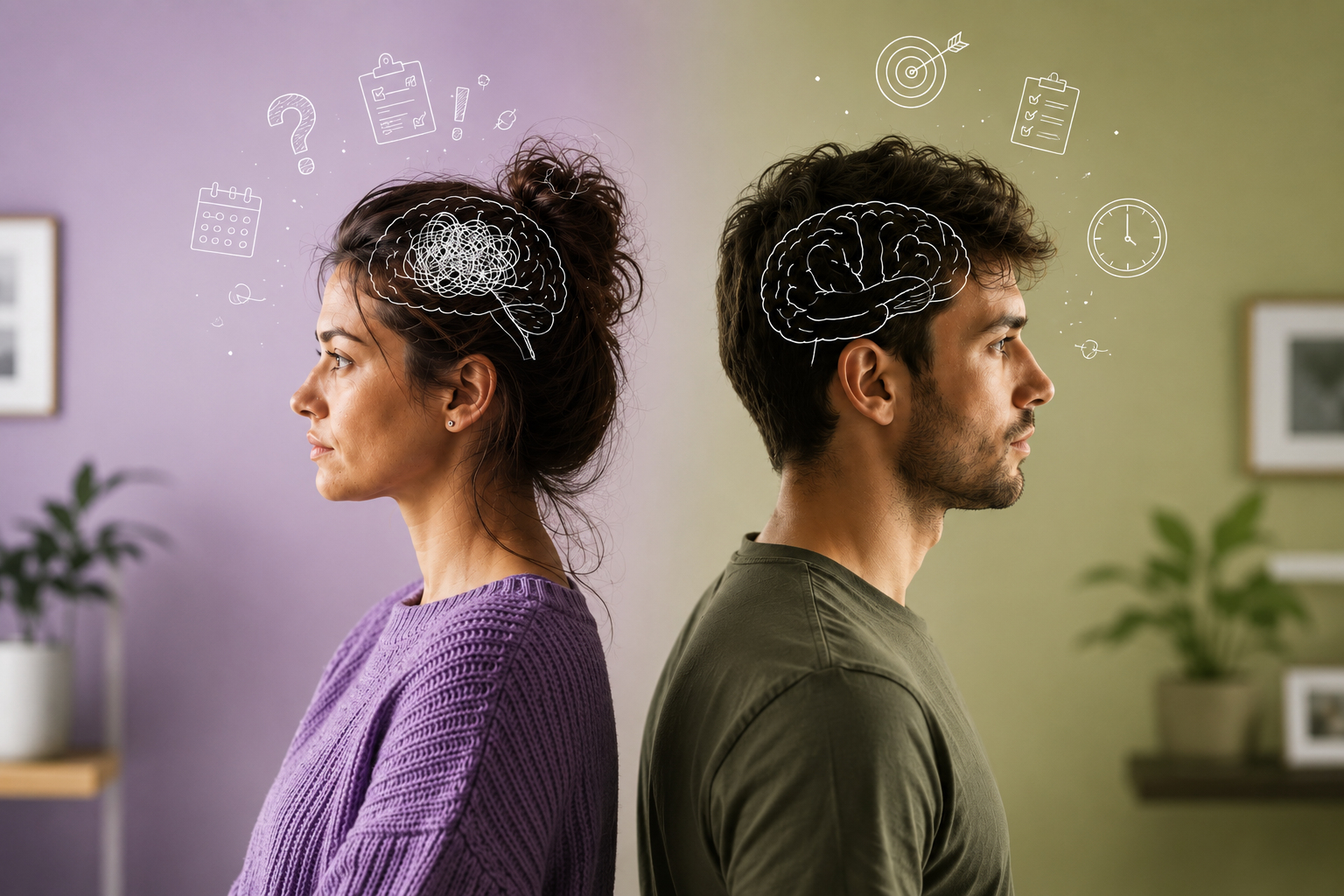
Biology is only half the story. The other half is how girls are raised.
Girls are often taught to sit still. To be polite. Do not make noise. So a girl with ADHD learns to cover it fast, a pattern known as ADHD masking. She becomes quiet. She becomes “the good one.” No one sees a problem, so no one looks for one.
Boys who act out get noticed and sent for help. Girls who struggle quietly get skipped over completely. That’s not about brains. That’s about who gets watched, and who doesn’t.
Put these two things together — hormones that shift her symptoms, plus a world that doesn’t expect her to struggle in the first place — and you get a huge number of women whose ADHD stays hidden for years.
Since hormones affect ADHD, it makes sense that symptoms shift at every big hormone stage in a woman’s life.
This is often when symptoms first get noticeably worse. Hormones start changing fast. Focus gets harder. Moods swing more. Many girls are told this is “just being a teenager.” Often, it’s more than that. It’s her first real brush with how much hormones affect her ADHD.
Estrogen rises and falls every single month. Right before her period, estrogen drops low. This is usually when symptoms hit hardest — worse focus, worse mood, more forgetfulness. Right after her period ends, estrogen rises again, and symptoms often ease up.
So her ADHD can feel mild one week, and rough the next. That’s not random, and it’s not “just PMS.” That’s her hormones directly affecting her dopamine.
Hormones shift a lot here too, and it goes both ways. Some women feel their ADHD ease up during pregnancy, when hormone levels are high and steady. Others feel it gets much worse after birth, when hormones drop fast and sleep disappears. This is also a common time for a woman to be diagnosed for the first time — new stress reveals a struggle that was always there.
This is the biggest shift of all. Estrogen drops, and keeps dropping, for years. Many women say their symptoms get noticeably worse in this stage — focus, memory, and mood all take a hit. Some are diagnosed for the very first time during menopause. They had it all along. It just got too loud, right when their hormone support disappeared, to keep ignoring.
You Can Also Read:
Three reasons.
The tests were made for boys. Long ago, doctors studied boys to learn about ADHD. So the checklist was built around boys. A quiet girl won’t match that list. Even if she struggles just as much.
This pattern is exactly why undiagnosed ADHD in adult women is so common. A woman can carry it for decades before anyone, including her, connects the dots.
ADHD masking is the quiet skill of covering up a struggle so well that it looks like it isn’t there at all.
It can look like:
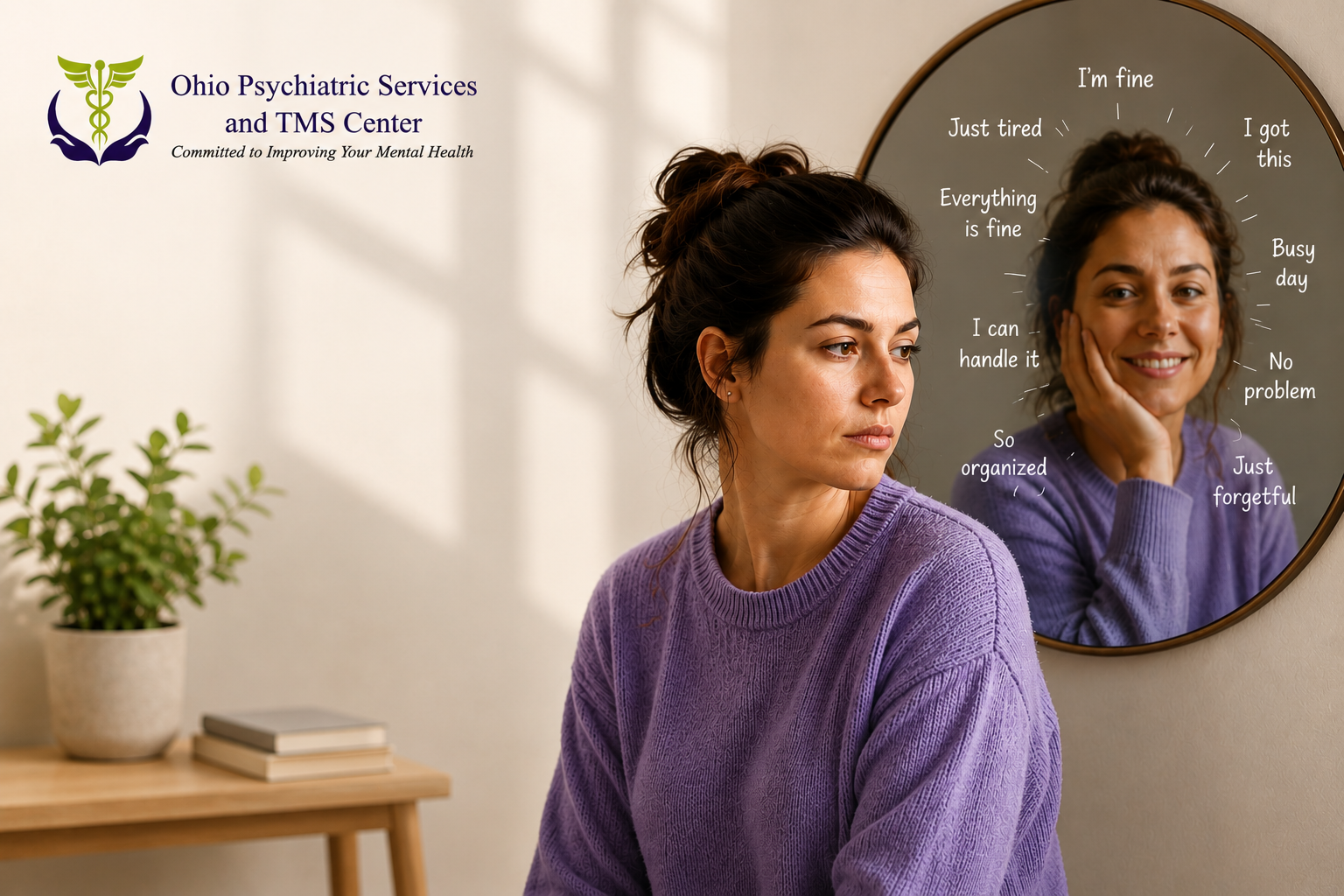
ADHD masking isn’t dishonesty. It’s survival. But it comes at a cost. The effort it takes to look fine all day is exhausting, and it’s a big reason undiagnosed ADHD in adult women goes unnoticed for so long. The mask works so well that even the woman wearing it forgets what’s underneath.
Medication isn’t the only path forward. Many women ask how to manage ADHD without medication, especially if they’re still weighing their options. A few things that help:
These strategies for how to manage ADHD in women without medication work best alongside professional support, not instead of it.
Stimulants are the most common ADHD treatment. But they aren’t the only ones. Some women get side effects from stimulants. Some just don’t fit that path. That’s where non-stimulant ADHD meds come in.
Non-stimulant ADHD meds tend to work slower than stimulants. But they can still help a lot. A doctor can walk through the options with you. Together, you can find what fits your symptoms, your hormones, and your stage of life.
An ADHD therapist does more than just listen. A good ADHD therapist helps you build real tools. Tools for focus. Tools for time. Tools for big feelings. An ADHD therapist can also help you unlearn years of ADHD masking, so you don’t have to fake “fine” all day.
Seeing an ADHD therapist and a doctor together often works best. This is true for women dealing with hormone shifts, non-stimulant ADHD meds, or any other med questions.
This isn’t anyone’s fault. Not the woman who has struggled. Not the doctors, using an old picture of ADHD. But this is changing. More women are getting diagnosed at 30, 40, and later. Many finally get an answer that fits.
Did any of this sound like you? That feeling matters. A doctor who understands ADHD symptoms in women can help. They can find the real cause — hormones, brain chemistry, and all — not just calm the surface.
ADHD can look different in women. Getting the right help starts with knowing that. At Ohio Psychiatric Services, we focus on your symptoms, your story, and your needs. Not a one-size-fits-all plan.
You don’t have to face ADHD, anxiety, depression, PTSD, OCD, or
treatment- resistant depression alone. Our experienced team will listen,
understand your concerns, and help you find the right path forward.

Yes. Some people with ADHD do not seem restless. They may mostly have trouble with focus, memory, or staying on task.
Hormone changes during your period can affect ADHD symptoms. You may notice more trouble with focus, mood, or energy.
Yes. ADHD can look like stress, anxiety, depression, or poor sleep. A doctor can help find the real cause.
It can. Hormone changes during menopause may make ADHD symptoms like poor focus and forgetfulness feel worse.
She may often lose things, forget tasks, struggle to focus, or have trouble staying organized. These signs should affect daily life.
ADHD can start in childhood, often before age 12. In girls, the signs may be easy to miss because of ADHD masking.
Yes. Girls with ADHD can get good grades. They may just need to work harder to stay focused and organized.
Treatment may include medicine, therapy, or daily skills. The right plan depends on the person’s needs.
Simple routines can help. Try using reminders, keeping a set schedule, getting enough sleep, and breaking tasks into small steps.
It may cause forgetfulness, missed tasks, poor time management, and trouble staying organized. It can also make work and daily life harder.
This article is for educational purposes and does not replace a comprehensive psychiatric evaluation. If you have concerns about ADHD symptoms in yourself or your child, contact Ohio Psychiatric Services to schedule an assessment.