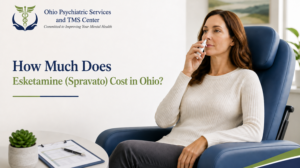
How Much Does Esketamine (Spravato) Cost in Ohio?
How Much Does Esketamine (Spravato) Cost in Ohio? Medically reviewed by Max M Haque, Cari…
or

At Ohio Psychiatric Services, we believe that mental wellness requires a deeply personalized approach. Your brain, your history, and your goals are entirely unique to you. That is why our team of psychiatric providers, therapists, and counselors work collaboratively to offer a full spectrum of compassionate mental health care - blending traditional healing with advanced, innovative clinical treatments.
Whether you are seeking a supportive, warm space to process life’s challenges, looking for careful and understanding medication management, or exploring breakthrough therapies for symptoms that haven't responded to traditional care, we are here to walk with you every step of the way. You don't have to navigate this journey alone.
Explore our comprehensive care options below to find the path that feels right for you:
Taking the first step toward mental health care can feel daunting, but you are in safe hands. Our comprehensive initial evaluations are unhurried, deeply validating conversations designed to understand the whole picture of who you are. We look beyond your symptoms to establish an accurate diagnosis and a clear, compassionate roadmap for your healing journey.
Finding the right balance with medication requires careful attention, expertise, and a provider who truly listens. Our ongoing services go far beyond simply writing a prescription. We partner with you to closely monitor how you are feeling, fine-tune dosages, and ensure your treatment safely supports your daily well-being.
Navigating life with a fast-moving brain can feel like an uphill battle against overwhelm and chronic stress. Our comprehensive ADHD testing provides clear answers and validation for adults and children alike. From there, we build a tailored treatment plan combining careful medication management and practical strategies to help you calm the chaos, regain your focus, and thrive.
(Esketamine) Nasal Spray
For many individuals, finding true relief means exploring alternative, natural pathways to healing. We provide comprehensive, compassionate evaluations to determine your eligibility for a medical marijuana card under Ohio state guidelines. Our goal is to safely and legally integrate this plant-based therapy into your broader mental wellness plan to help alleviate chronic distress and improve your daily quality of life.
(Esketamine) Nasal Spray
A fast-acting, in-office treatment administered in a safe, comforting environment, specifically designed for adults finding it difficult to find relief from severe depression.
Also available: Genetic Testing · Telehealth · Urgent Primary Care Services
At Ohio Psychiatric Services, we understand that living with mental health challenges can feel overwhelming, exhausting, and deeply isolating. Whether you are dealing with a sudden crisis or managing a long-standing, complex condition, your struggles are valid and relief is possible. Our team meets you exactly where you are with a combination of deep empathy, advanced clinical expertise, and a commitment to finding a treatment plan that actually works for your life.
We provide comprehensive, specialized care for a wide range of psychological and psychiatric conditions, including:
Also treat: Dementia · Insomnia · Panic Disorder · Substance Induced Psychosis · Schizophrenia
Free TMS or Spravato® consultations for patients with treatment-resistant depression

If you’ve tried multiple antidepressants and still don’t feel like yourself, it can be discouraging and exhausting. Treatment‑resistant depression (TRD) is more common than many people realize, and it does not mean you have run out of options or it is a sign that you are not trying hard enough. Advances in depression treatment, including Spravato (esketamine), are offering renewed hope to individuals who have struggled to find relief through traditional approaches.
Spravato (esketamine) nasal spray was developed specifically for adults in this situation. It is the only FDA‑approved nasal spray for treatment‑resistant depression and can be used on its own or alongside an oral antidepressant. For people seeking advanced depression treatment or alternatives to antidepressants in Columbus, Ohio area, understanding how Spravato works and what the research shows can make next steps feel clearer and more hopeful.
Most antidepressants gradually change serotonin or norepinephrine levels and often take several weeks to work. Spravato targets a different system: the glutamate pathway.
Esketamine briefly blocks NMDA receptors, triggering a surge of glutamate and activating AMPA receptors. This increases a growth factor (BDNF) that supports neuroplasticity, the brain’s ability to form new, healthier connections. In depression, brain pathways can become rigid and locked into negative patterns. Spravato helps interrupt those patterns and gives your brain a chance to ‘reset’ and build new routes instead of staying stuck in the same loop.
Because it acts directly on these circuits, some patients notice a shift in symptoms within hours to days, rather than waiting weeks as with standard antidepressants alone.
A key difference between Spravato and many oral antidepressants is speed. While typical medications may take four to six weeks to show full effect, Spravato often acts sooner.
Many people experience a pattern like this:
Each person’s course is unique. How long you have been depressed, what you have already tried, other medical conditions, and whether you are also in therapy or TMS will all influence how quickly and how strongly you respond.
Clinical trials and real‑world data show that Spravato can bring meaningful relief to adults with treatment‑resistant depression who have not improved enough with at least two antidepressants. These results are especially important because they come from a group that is often hardest to treat.
Studies have found:
People who respond often describe clearer thinking, better energy, renewed interest in activities, and a stronger ability to connect with others, not just a small lift in mood.

Ohio Psychiatric Services provides Spravato treatment in Columbus and Lancaster, Ohio in a structured, supportive setting.
Step 1: Comprehensive evaluation
Your care starts with a psychiatric evaluation. A psychiatrist reviews your depression history, previous medications, current symptoms, and medical background to confirm whether Spravato is appropriate and safe. This visit is also a time to discuss your goals and concerns.
Step 2: Insurance review and approval
If Spravato appears to be a good fit, the OPS team helps with insurance verification and prior authorization. Many major insurance plans now provide coverage for Spravato for treatment‑resistant depression, when medical necessity criteria are met, although prior authorization is typically required. Trained staff will explain the expected costs and scheduling so you know what to expect.
Step 3: Induction phase (first month)
Once approved, you start the induction phase:
Because Spravato can cause temporary sedation or dissociation, you will need a ride home and should not drive or operate machinery for the rest of the day. Spravato cannot be taken at home; all doses are given in a certified clinic under a REMS safety program.
Step 4: Maintenance phase
If you respond to Spravato, your psychiatrist will transition you to a maintenance schedule. Many people start with weekly sessions and then move to every one to two weeks as symptoms stabilize. The goal is to maintain progress with the lowest effective treatment frequency.
Spravato may be used on its own or combined with an oral antidepressant, allowing your provider to tailor your plan to your history, preferences, and side‑effect profile.
Most Spravato side effects are short‑lived and occur around the time of each treatment. Many people find side effects lessen as they continue treatment and become more familiar with the process. Common experiences include:
These are the main reasons treatment happens in a clinic with monitoring instead of at home. Some patients also describe the treatment experience as calming or reflective. Having a dedicated team present throughout the monitoring period often helps patients feel reassured and supported.
Spravato may not be right for everyone. Aneurysmal vascular disease, a history of brain hemorrhage (stroke), severe or uncontrolled hypertension or pregnancy may make other treatment options more suitable. Your OPS psychiatrist will review your medical history and current medications carefully before starting.
At OPS, Spravato is one part of a broader, personalized approach to depression care in Central Ohio. In addition to esketamine therapy, we also offer:
This allows your treatment‑resistant depression plan in Columbus, Ohio to be built around you, not just a single medication or procedure. For some people, Spravato is the missing piece that finally moves the needle after years of trial and error. For others, it becomes a key part of a combined strategy that includes TMS, medication adjustments, and therapy.
If you have tried multiple medications and continue to struggle with depression, you do not have to navigate the next steps alone. The team at Ohio Psychiatric Services can help you determine whether Spravato, TMS, or another advanced treatment option may be right for you and create a personalized plan designed to help you regain hope and improve your quality of life.